
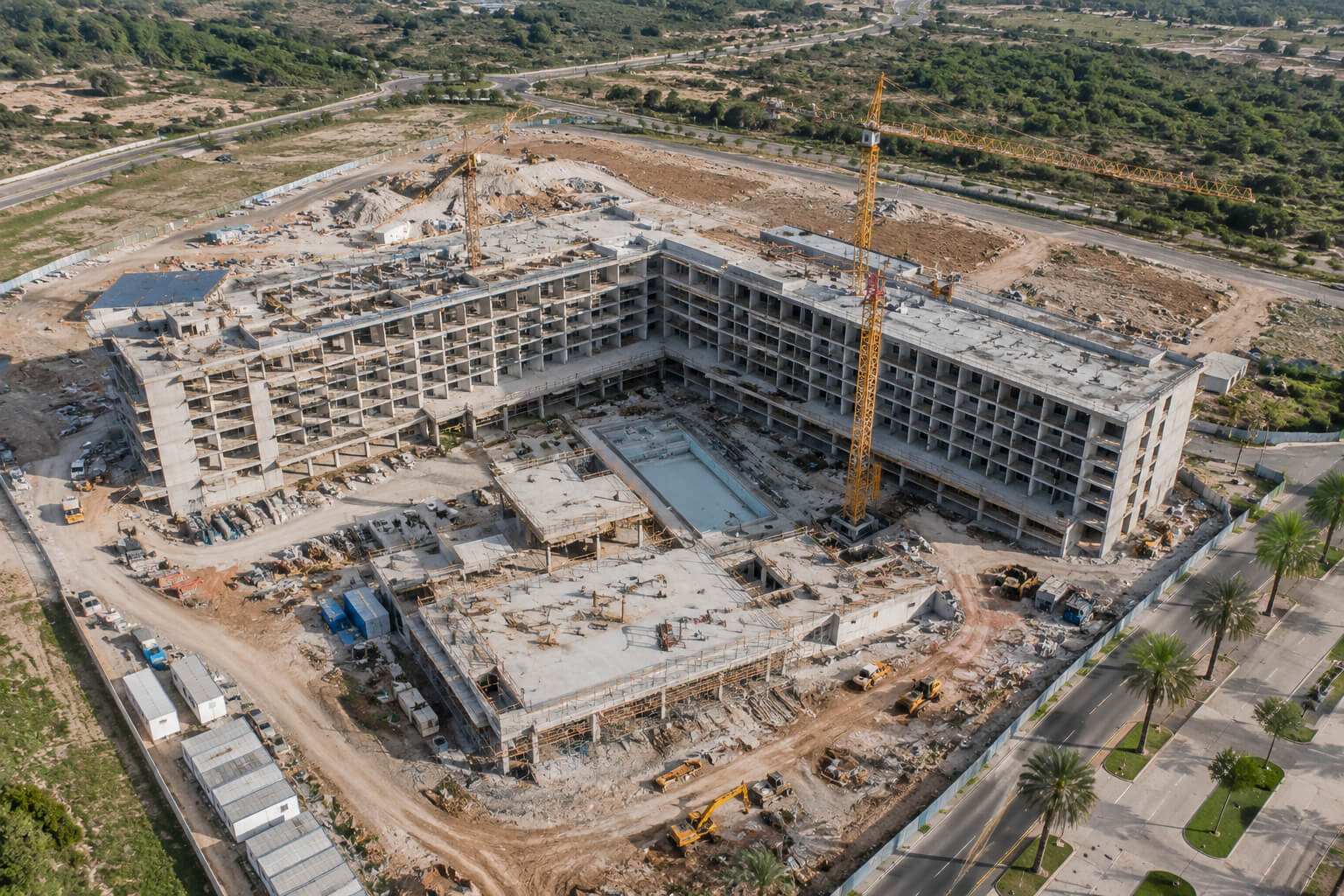
A hotel development can have an attractive location; strong demand and an experienced development team yet still struggle to secure funding if the capital structure is wrong. The person facing this problem is usually the developer, project sponsor, property owner, investor or finance director responsible for turning a proposed hospitality project into a financeable transaction. The challenge is not simply finding a lender. It is determining how much equity the project needs, how much senior debt its cost and value can support, whether mezzanine or other structured capital is appropriate, and how the construction facility will ultimately be repaid. This guide from Bear Capital Ventures Limited looks at those decisions in practical terms, helping you understand what lenders assess, what documentation matters, where the main risks sit and how to prepare a credible funding strategy.
Start With the Project, Not the Loan
The first question is not “How much can I borrow?”
It is:
What capital structure allows this hotel to be completed, opened, stabilised and refinanced or sold without creating an unmanageable funding gap?
Hotel development finance is different from financing an established trading hotel. During construction, there may be no operating income, while the lender is exposed to planning, construction, cost, programme and market risk. At completion, the value of the asset also depends on the performance of the hotel as an operating business.
Current specialist hotel-finance guidance reflects this distinction: lenders assess the build, contractor, programme, operator, projected trading performance and eventual exit rather than simply lending against the underlying land.
Bear Capital Ventures Limited can discuss project finance and structured funding requirements with developers seeking to determine how their particular project should be financed. The appropriate structure depends on the project, jurisdiction, sponsor, documentation, security and participating funder’s approval.
Ready to Secure Financing?
Discuss your requirements with our specialists and explore a finance structure aligned with your objectives.
What Does the Hotel Capital Stack Look Like?
A typical development may combine several sources of capital rather than relying on one facility.
Sponsor or developer equity normally provides the first-loss capital and demonstrates financial commitment to the project. It may include cash equity, contributed land or other eligible sponsor capital.
Senior development debt generally provides the largest debt component. It is normally secured against the development and drawn progressively as construction advances.
Mezzanine finance or preferred equity can sometimes fill part of the gap between senior debt and the sponsor’s available equity. It can increase leverage, but it also increases the project’s financing cost and repayment burden.
Joint-venture or institutional equity may be appropriate for larger projects where the sponsor wants additional capital, expertise or risk-sharing.
Structured or alternative finance may become relevant where a conventional senior facility does not fully address the project’s capital requirement, provided the structure is acceptable to the relevant funders.
The right combination depends on the economics of the project. More leverage is not automatically better. The cheapest structure is not necessarily the best structure either if restrictive covenants, excessive equity requirements or an inflexible exit make completion harder.
Bear Capital Ventures Limited identifies a stable, well-structured combination of debt and equity as a fundamental component of successful hotel development.
How Much Debt Can the Project Support?
Two calculations are particularly important: loan-to-cost (LTC) and loan-to-gross-development-value (LTGDV).
LTC compares the proposed facility with eligible project costs.
For example:
- Total development cost: £20 million
- Senior facility: £12 million
- LTC: 60%
LTGDV compares the facility with the expected value of the completed development.
If the completed hotel is independently assessed at £24 million:
- Senior facility: £12 million
- GDV: £24 million
- LTGDV: 50%
A lender may impose both tests, meaning the final facility is constrained by whichever measure produces the lower permissible advance. Bear Capital describes its underwriting in these terms, although actual leverage varies materially by project and lender.
For a new hotel, GDV is particularly important because the completed property is valued as a hospitality business as well as real estate. Forecast occupancy, ADR, RevPAR, EBITDA, operator quality, location and comparable evidence can all influence the valuation.
Bear Capital’s current hotel-development guidance illustrates the point by modelling projected ADR and occupancy into revenue, EBITDA and an investment yield to derive an indicative trading value.

What Lenders Will Actually Underwrite
A lender is effectively asking five questions.
1. Is the project legally and practically ready?
Planning, land ownership, title, permits, zoning or change-of-use requirements and other statutory approvals need to be sufficiently advanced for the proposed financing.
2. Can the project be built for the stated cost?
A credible cost plan, experienced contractor, construction programme, professional team and appropriate contingency are essential. Cost overruns are particularly dangerous when the senior facility is already constrained by GDV.
3. Will the completed hotel perform?
The lender will scrutinise the market, location, competitive supply, room count, positioning, ADR, occupancy and projected operating margins.
4. Who will operate it?
An established brand, franchise, lease, management agreement or experienced independent operator can materially strengthen the credit case. Specialist lenders explicitly identify operator commitment and brand affiliation as important considerations.
5. How does the lender get repaid?
The development facility may ultimately be repaid through a sale, refinancing into permanent hotel debt, or another agreed exit. That exit should be considered when the development is structured not after construction is finished.
Documents That Strengthen the Funding Case
A financing submission should normally be built around evidence rather than optimistic assumptions.
Depending on the transaction, expect to prepare:
- Detailed development budget and sources-and-uses statement
- Planning and property documentation
- Construction programme and contractor information
- Quantity surveyor or cost-consultant information
- Independent valuation or feasibility evidence
- Hotel market and demand analysis
- Operating projections and financial model
- ADR, occupancy, RevPAR and EBITDA assumptions
- Brand, franchise or operator documentation where applicable
- Sponsor track record and financial information
- Evidence of available equity
- Proposed security structure
- Detailed exit strategy
- Corporate and beneficial-ownership information
- Relevant legal, tax and technical reports
The objective is to let a credit committee understand the entire transaction without having to reconstruct the business case from disconnected documents.
The Risks That Can Break the Capital Stack
The biggest mistake is modelling only the base case.
A developer should test what happens if construction costs rise, practical completion is delayed, opening takes longer than expected, occupancy ramps more slowly, ADR underperforms, interest costs increase or the completed valuation is below the original forecast.
For example, suppose a £20 million project is structured around £12 million of senior debt and £8 million of equity. A material cost overrun does not automatically mean the lender will increase its commitment. If the lender’s maximum LTC and LTGDV limits have already been reached, the sponsor may have to provide additional equity.
That is why contingency, interest reserves and a realistic opening period should be incorporated into the initial funding model.
Mezzanine or preferred equity can sometimes reduce the immediate equity requirement, but the higher cost of junior capital can weaken project returns and create additional repayment pressure. Bear Capital Ventures Limited notes that mezzanine can sit behind senior development debt where the scheme and economics support it.
Ready to Secure Financing?
Discuss your requirements with our specialists and explore a finance structure aligned with your objectives.
Where Structured Finance May Fit
Not every hotel development needs sophisticated structured finance.
For a straightforward, well-capitalised project with strong planning, an experienced sponsor, credible operator and conservative valuation, conventional senior development finance may be the most efficient route.
More complex projects may require a combination of senior debt, equity, mezzanine, joint-venture capital or other structured solutions.
Bank Guarantees and Standby Letters of Credit should not automatically be treated as substitutes for development equity or a construction loan. They are financial instruments that can support defined contractual or payment obligations, and their usefulness depends on the transaction, issuing institution, beneficiary requirements and the structure acceptable to the relevant funders.
Bear Capital Ventures Limited works across project finance, structured finance, Bank Guarantees and SBLC-related solutions, so a discussion can determine whether any such instrument is genuinely relevant rather than forcing an unsuitable product into the capital stack.
Build the Exit Before You Build the Hotel
A development loan is temporary capital.
The permanent financing or sale strategy therefore needs to be credible before the first major drawdown.
The stronger the evidence supporting the final stage, the easier it is to explain why the development facility can ultimately be repaid.
Some specialist hotel lenders explicitly structure development finance around a stabilised refinance or sale from the outset.
What a Financeable Hotel Project Looks Like
There is no universal percentage of debt or equity that makes a hotel financeable.
A strong project is one where:
- The total cost is realistic and independently supportable.
- The sponsor has sufficient financial commitment.
- Planning and legal matters are sufficiently advanced.
- The construction team can deliver the project.
- The operator and brand strategy are credible.
- Trading assumptions can withstand independent scrutiny.
- The completed value supports the proposed debt.
- Contingency is adequate.
- The development timetable is realistic.
- The exit is identifiable and achievable.
The best capital structure is therefore not the one that maximises headline leverage. It is the one that gives the project enough capital to reach stabilised operations while keeping debt service, equity risk and exit requirements manageable.
How Bear Capital Ventures Limited Can Help
For a developer, the first useful conversation should be about the transaction, not a predetermined financial product.
Bear Capital Ventures Limited works with project developers, investors, businesses and other clients seeking project finance and structured capital solutions across international markets. Its stated services include project financing, corporate finance, trade finance, working capital and financial instruments such as Bank Guarantees and SBLCs.
Where appropriate, financing may be arranged through established banking or financial institutions, specialist lenders or other participating capital providers, subject to the transaction’s requirements, availability, due diligence and the relevant institution’s approval.
If you are planning a hotel development, the productive next step is to prepare the core project facts: location, acquisition cost, total development cost, planning status, room count, operator or brand position, construction programme, projected GDV, sponsor equity and proposed exit.
Bear Capital Ventures Limited can then assess the requirement and explore whether project finance, structured finance or another capital solution is appropriate for the transaction.
Discuss Your Financing Requirement with Bear Capital Ventures Limited
Frequently Asked Questions
How much equity is normally required for hotel development finance?
There is no universal requirement. The sponsor’s equity depends on the project’s LTC and LTGDV limits, valuation, risk profile, lender appetite and whether additional capital such as mezzanine or preferred equity is used.
Can a first-time hotel developer obtain development finance?
Potentially. A first-time sponsor can strengthen the case by bringing an experienced hotel operator, contractor, development team and professional advisers. The project’s economics and evidence remain more important than simply being able to present a compelling concept.
Can hotel development finance include land acquisition?
It can, depending on the structure and lender. The treatment of land already owned by the sponsor, land being acquired and the timing of the acquisition should be modelled before the facility is negotiated.
Is an SBLC a replacement for hotel development finance?
Generally, it should not be assumed to be. An SBLC is a contingent financial instrument rather than automatically being equivalent to construction cash or sponsor equity. Whether it can support a particular transaction depends on the underlying obligation and the requirements of the relevant financial institutions.
What should I prepare before approaching a hotel finance provider?
Prepare the project budget, planning position, development programme, operator information, trading projections, valuation assumptions, sponsor track record, available equity, security information and proposed exit. A coherent funding model makes it much easier to assess the project’s actual financing requirement.
Turn the Hotel Concept into a Financeable Transaction
A hotel development becomes easier to finance when the numbers, operator, construction plan, capital stack and exit all tell the same story.
If you have a hospitality project in development, the most useful next step is not to request a generic loan quotation. It is to have the entire transaction assessed together including the funding gap, valuation constraints, equity requirement, potential debt structure and eventual exit. Submit Your Project to Bear Capital Ventures Limited
Written by Bear Capital Ventures Limited
Bear Capital Ventures Limited specializes in educational content covering global finance, trade finance solutions, corporate funding, financial instruments, and international capital markets. We provide insights into structured finance solutions, Bank Guarantees, Standby Letters of Credit and business funding strategies for organizations exploring global growth opportunities.